🚨 SEO Is No Longer Enough: The Rise of AEO and GEO
"If you're not optimizing for how AI finds and displays your content — you're already falling behind."
We’ve entered a new era of search and content visibility.
If you’re still only focused on SEO, you're likely missing out on the two fastest-growing areas in discoverability:
✅ AEO – Answer Engine Optimization
✅ GEO – Generative Engine Optimization

This post breaks down what they are, how they differ, and what to do now to future-proof your content strategy.
🧭 What Are SEO, AEO, and GEO?
🔍 SEO (Search Engine Optimization)
Traditional search optimization — making your website appear higher on Google/Bing via:
-
Keywords
-
Meta titles & descriptions
-
Backlinks
-
Site performance
Goal: Get clicks from search engine results pages (SERPs).

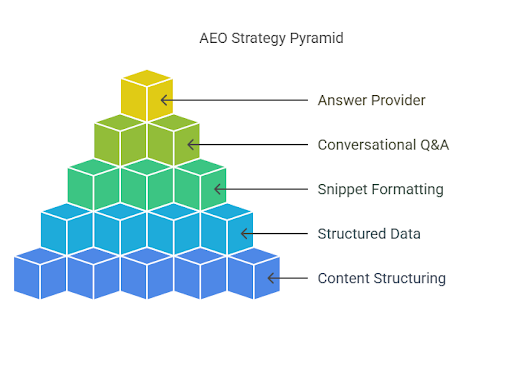
💡 AEO (Answer Engine Optimization)
AEO is about structuring your content to get picked up as direct answers in:
-
Featured Snippets
-
Voice searches (Siri, Alexa, Google Assistant)
-
Smart summaries (Google's AI Overviews, Bing AI)
You’ll want:
-
Structured data (Schema.org)
-
FAQ-style formatting
-
Concise, direct answers to common questions
Goal: Become the answer, not just a link.
🤖 GEO (Generative Engine Optimization)
GEO is brand new — optimizing content so that AI tools like ChatGPT, Perplexity, and Gemini:
-
Understand your content
-
Use it as a source
-
Mention or summarize it in AI-generated responses
To rank in generative engines, you need:
-
High-quality, fact-based content
-
Clear structure
-
Context-rich and original insights
Goal: Be cited or summarized by AI engines, even without a visible backlink.

🆚 How They Differ
| Attribute | SEO | AEO | GEO |
|---|---|---|---|
| 📈 Focus | Rankings | Direct answers | Generative inclusion |
| 🧠 Engine Type | Search engine | Answer engine | Generative AI |
| 🛠 Techniques | Keywords, meta, links | Schema, Q&A, snippets | Rich, structured knowledge |
| 🎯 Outcome | Click-throughs | Voice answers | AI citations/mentions |

🔧 Action Plan: How to Future-Proof Your Content
If you're a marketer, creator, or business owner, here’s your roadmap:
✅ 1. Use Structured Data
Add Schema.org tags (FAQ, Article, Product) via JSON-LD to help AI read your pages semantically.
✅ 2. Write in Questions and Answers
Use conversational subheadings like:
"What is Generative Engine Optimization?"
"How do I optimize content for ChatGPT?"
Then answer them clearly and briefly.
✅ 3. Create Source-Friendly Content
Think: context-rich, accurate, and useful.
-
Reference authoritative sources
-
Avoid clickbait or fluff
-
Add original thought
✅ 4. Test on Emerging Engines
Search your keywords on:
-
Perplexity.ai
-
You.com
-
ChatGPT (with Browse)
And see what content is being shown — is yours there?

🚀 Why It Matters
AI is not just changing how people search — it’s changing what gets found.
Your high-ranking SEO page might not even be referenced by ChatGPT or Google's AI Overviews unless it's structured correctly.
Without AEO and GEO:
-
Your visibility will drop on new platforms
-
You’ll miss traffic from voice, smart summaries, and AI answers
-
Competitors with AI-ready content will dominate

🎯 Final Thought
Ask yourself:
Are you optimizing for Google?
Or are you preparing for a world where AI is the search engine?
If it’s the latter — it’s time to add AEO and GEO to your strategy.
💬 What About You?
Which one are you focused on in your content:
SEO, AEO, or GEO?
Comments
Post a Comment